Christ the Redeemer


Guanabara Bay (literally Bosom of the Sea)
The famous Christ the Redeemer statue is regarded as one of the Seven wonders of the new world on a list assembled in 2007. It stands 39m including a 10m pedestal. It is a worldwide symbol for peace
 |
| Christ the Redeemer statue stands on Corcovado Mountain. The visual effect is refections on the bus window |
It stands on the 700m high granite domed peak of Corcovado mountain (meaning 'hunchback' in Portuguese) in the Tijuca Forest National Park which is west of the city but wholly within the city limits.
The statue was constructed between 1922 and 1931 - designed by a local engineer, Heitor de Silva Costa and sculpted by a French sculptor, Paul Landowski.
It is made of reinforced concrete with outer layers of Swedish soapstone (chosen for its durability and ease of work).
The construction was entirely funded by the Catholic community of Brazil.

Access is via the Corcovado Rack Railway (or alternatively via a narrow winding road). The rack railway is electric and was opened in 1884 and refurbished in 1980.
 |
| The outstretched arms resemble the cross |
The views of the city from here are incredible, the mountains and the sea make the setting very alluring
 |
| Sugarloaf is center-shot, Cabritos Hill on the right |
 |
| Looking North East, Botafogo Bay is in front of Sugarloaf Mountain |
 |
| Looking East, the Jockey Club is in the foreground and Copacabana Beach is on the Atlantic Coast. Cantagalo Hill is on the right |
 |
| Looking South east, the Rodrigo de Freitas Lake. It will be the venue for rowing and canoeing events at the 2016 summer Olympic games. It has a 8 Km pathway circling the lake and is popular for walkers, skaters and cyclists. |

 |
| This capuchin monkey looks like he posed for the photo |

Sugarloaf Mountain (Pao de Acucar in Portuguese) is almost 400m high and is a striking natural landmark that rises straight from the water's edge. It sits at the entrance to Guanabara Bay and overlooks Rio de Janeiro.
 |
| Sugarloaf from Botafolo Beach, Urca's mountain is the closer, lower peak. |

Two italian-made, glass-walled cable cars travel to the summit where stunning view of Rio and its beautiful landscape can be seen.
 |
| The first cable car goes to Urca's Mountain 220m |
 |
| The second ascends to Sugarloaf |

Because Sugarloaf is on a peninsular that stretches into the Atlantic ocean, it offers a scenic views of a bustling city, a tranquil bay and a sparkling ocean.
 |
| Corcovado Mountain in the distance with Christ the Redeemer statue |

 |
| Copacabana Beach seen from Sugarloaf Mountain. Babylon Mountain is in the foreground. |


 |
| Looking North, Guanabara Bay reaches about 30Km inland and small hills that originally lined the bay were flatted and used as landfill. Santos Dumont airport, Rio's city airport is on the right. The International airport is further North of the city The 13.3 Km box girder bridge is in the background, nicknamed the Rio-Niteroi Bridge (officially the President Costa e Silva after the Brazilian President who order its construction in 1968) It saves a 100Km trip round Guanabara Bay from Rio to the municipality of Niteroi. |
 |
| A large vessel being towed in the bay. The town of Niterio is in the background |
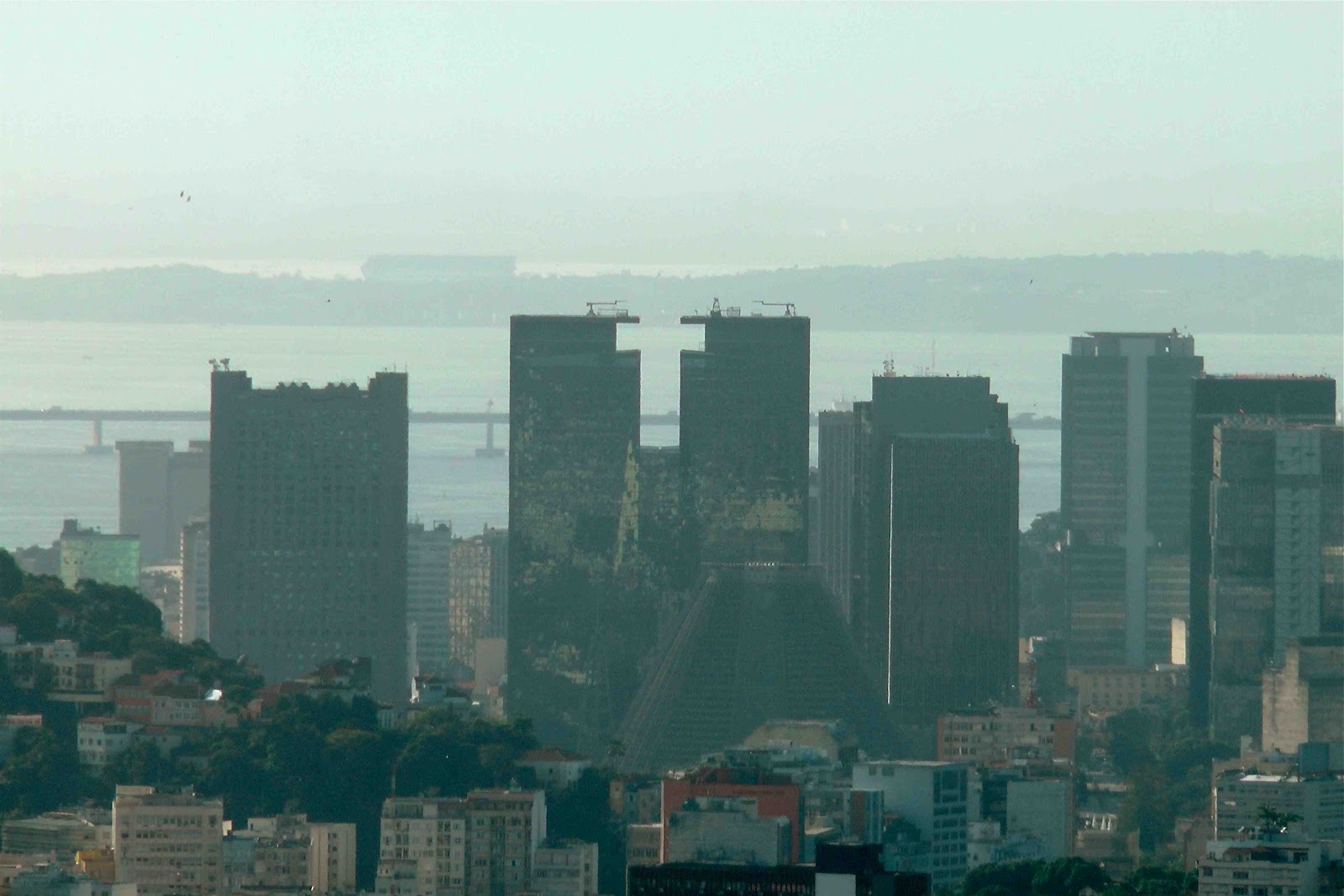 |
A cross is being incorporated into this city building
|
Guanabara Bay (literally Bosom of the Sea)
Is a body of water which stretches over 30Km inland and has over 130 islands. Originally it was thought to be a river when discovered on 1st January 1502, and named the River of January (Rio de Janeiro)
Rio-Niteroi Bridge.
 |
The
central span is 72m above the water to allow passage of large ships that use
the bay. It was completed in 1974, having taken just under 6 years to
build.
|
The
Cathedral of San Sebastian - Rio de Janeiro Cathedral
In
contrast to the baroque style of other churches, this church has a unique
beehive concrete exterior and outstanding stained glass windows and interior
that feels warm and inviting yet has a capacity of over 20,000.


 |
| A modern office block opposite the church has its interesting shape reflected on its glass |
Rio Sambodromo
The wild celebration held 46days before Easter in Rio is called Carnivale. It is held in Sambodromo which is a dedicated area of stands and a variety of seating and boxes with a total capacity of 25,700. At other time the boxes are classrooms in what is a poor favela (shanty town) neighbourhood. Free education is available to all children in Brazil.


 |
| Dolls and costumes are made all year |


